Blog
Looking for what to do in Corsica without emptying your wallet? Good news: the Isle of Beauty is packed with free or nearly free activities, from the calanques of Piana to white sand beaches, via perched villages and colourful markets.
Here’s our top 5 must-sees, detailed from north to south, to help you enjoy a stay full of nature, sea and heritage without breaking the bank at a budget campsite!
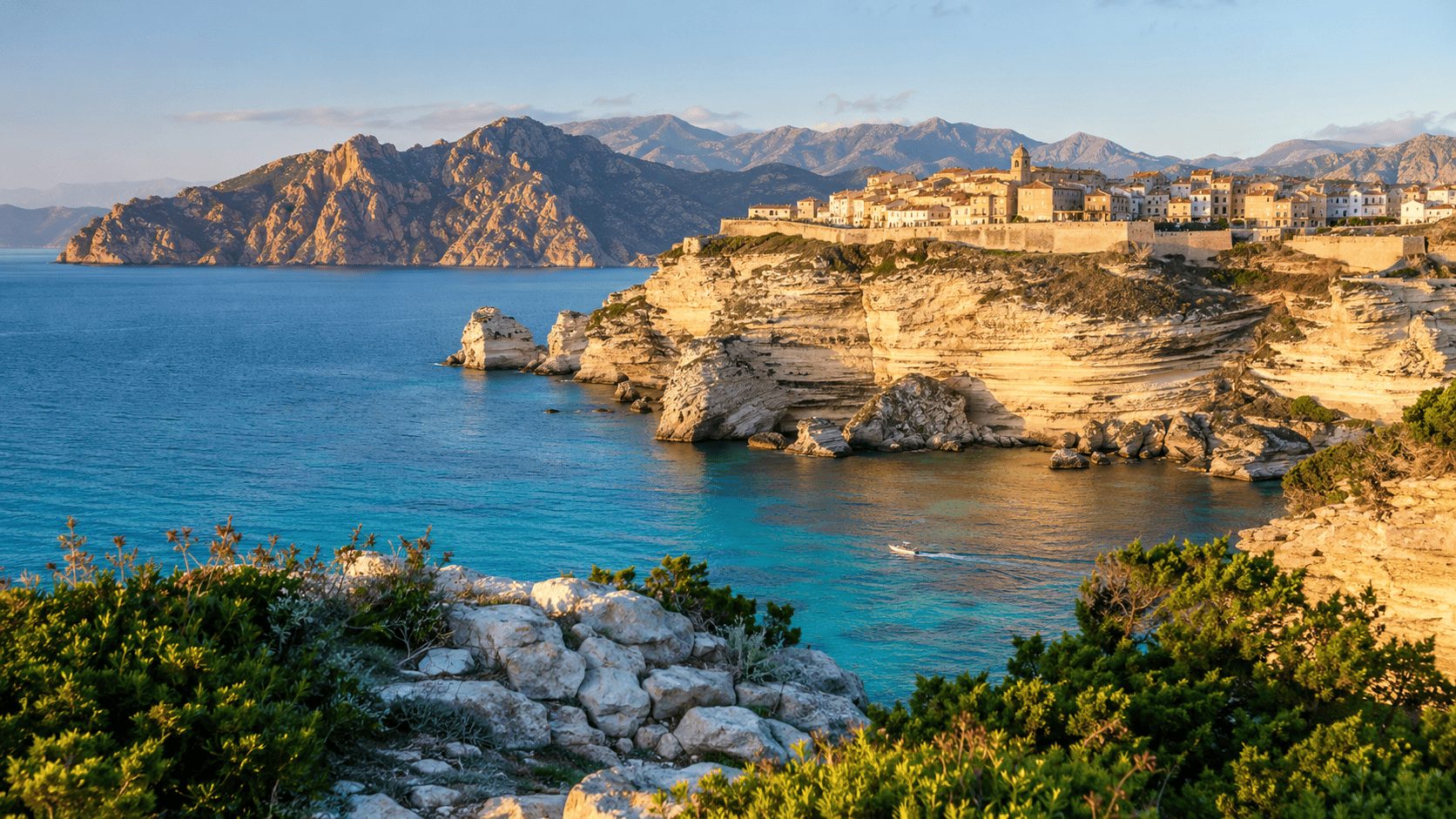
At the very southern tip of the island, Bonifacio ranks among the must-sees of Corsica. Its high medieval old town stands atop limestone cliffs over 60 metres high, offering a dizzying view of the sea. From the harbour, a full-day boat excursion leads to the Lavezzi Islands, an archipelago of 23 islets classified as a nature reserve, about 10 km offshore. Diving enthusiasts discover crystal-clear waters and granite seabeds there. Legend has it that the King of Aragon’s staircase, with its 187 steps carved into the cliff, was dug out in a single night — in reality, Franciscan monks built it to reach a freshwater spring.
Visitors’ favourite moment: many travellers hold onto a strong memory of the boat trip at the foot of the cliffs, when the boat weaves into the sea caves with their blue-tinted glow. The late-afternoon light on the citadel, seen from the water, remains one of the highlights of a stay in Bonifacio.
On the west coast, the Gulf of Porto brings together two wonders that have been UNESCO World Heritage sites since 1983: the calanques of Piana and the Scandola nature reserve. The calanques of Piana can be explored on foot along free paths, among red porphyry spires plunging into the sea. As early as 1880, the dazzled writer Guy de Maupassant compared these rocks to petrified legendary figures. The Scandola reserve, meanwhile, can only be visited by boat excursion, as there’s no road access. It is the last Mediterranean refuge of the osprey, an extremely rare sea eagle. Allow half a day to enjoy this wild nature.
Visitors recommend: to capture the full magic of the calanques of Piana, many advise going at sunset, when the porphyry glows red and orange. On the Scandola side, small-boat trips let you approach the coves and caves up close, where protected sea birds nest.
At the heart of the island, Corte embodies inland, mountainous Corsica, far from the beaches. Once the capital of Pasquale Paoli’s Corsica, the town today hosts the island’s only university. From Corte, the Restonica valley climbs towards peaks over 2,000 metres high, within the Regional Nature Park of Corsica. It offers a legendary hike to Lake Melo, at 1,711 metres, and Lake Capitello, at 1,930 metres. Allow around 4 hours there and back from the Grotelle sheepfold, on a trail that joins the famous GR20. Along the way, clear rock pools invite you to swim in the river.
Our favourite: in the cool early morning, before the hikers arrive, the climb to the lakes offers a rare silence, broken only by the sound of flock bells. Visitors often mention the emerald colour of Lake Capitello, ringed by steep rock walls, as the most striking image of their stay in the Corsican mountains.
In the north-west, Calvi seduces with its Genoese citadel overlooking a long sandy beach and a turquoise bay. The old town can be explored freely, between ramparts and history-steeped alleyways; Calvi even claims to be the birthplace of Christopher Columbus. All around, the Balagne region unfurls its perched villages such as Sant’Antonino or Pigna, renowned for their craftspeople and their sea views. This corner of the north makes an ideal base from which to set off by car to other destinations. Between heritage, beach and hinterland, Calvi offers a concentrate of authentic Corsica, without spending a fortune.
Visitors’ favourite moment: strolling at sunset through the alleys of Sant’Antonino, one of the oldest villages in Balagne, wins over most travellers. Many head home with olive oil or Corsican biscuits bought directly from producers, a tasty souvenir that extends the trip long after returning.
On the south-west coast, Ajaccio blends city life with the seaside. As the birthplace of Napoleon Bonaparte, the imperial city charms with its colourful market, lively alleyways and the Maison Bonaparte, now a museum. A guided tour of the centre, led by a local guide, reveals its heritage without breaking the bank, while nearby beaches guarantee swimming and lazing about. Heading east, Porto-Vecchio and its famous beaches of Palombaggia and Santa Giulia round out a stay in the south perfectly. Whether with family or as a couple, Ajaccio remains an excellent starting point for exploring the island.
Visitors recommend: the morning market on Place Foch is universally loved for tasting cold cuts, brocciu and sheep’s cheese at low prices. Many travellers take the opportunity to put together a picnic and head to a nearby beach — a simple, convivial way to enjoy Corsica without straining the budget.
A budget trip to Corsica is planned well before departure, since transport and accommodation weigh heavily on the bill. The ferry crossing, from Marseille, Toulon or Nice to Bastia or Ajaccio, is ideally booked several months in advance. Once there, renting a car helps you build a flexible itinerary from north to south.
Here are the most effective ways to bring down the bill:
“What really weighs on a Corsican budget is the ferry and the car: booked early and combined with a VACAF-approved campsite, they make the trip genuinely affordable for families,” our team explains.
Feel like discovering Corsica without blowing your holiday budget? Compare budget campsites in Corsica now and book your ideal base to string together all these experiences!
To visit Corsica, a north-to-south driving itinerary works very well: Bastia and Cap Corse, then Calvi and Balagne, before Porto, Ajaccio and Bonifacio. Allow at least a week to link these destinations at a relaxed pace, since mountain roads slow down travel times.
Yes, you can take a boat trip to the Lavezzi Islands departing from the port of Bonifacio. The boats offer day trips to this nature reserve, often combined with a visit to the caves and cliffs. It’s one of the best diving and swimming outings in the south of the island.
The best time to visit Corsica runs from May to June and in September. The climate stays mild, the sea is pleasant and prices drop compared with July and August. You’ll also enjoy far less crowded sites, ideal for a relaxed stay on the island.
To get to Corsica without breaking the bank, book your ferry several months ahead to Bastia or Ajaccio, from Marseille, Toulon or Nice. Overnight crossings and travelling outside school holidays offer the best rates. Low-cost flights can also help out, depending on current promotions.